

New data from the NATALEE trial reveals ribociclib significantly improves invasive disease-free survival in HR+/HER2– early breast cancer.
New data from the NATALEE trial reveals ribociclib significantly improves invasive disease-free survival in HR+/HER2– early breast cancer.

Adjuvant abemaciclib plus endocrine therapy significantly enhances overall survival in high-risk HR-positive HER2-negative breast cancer.
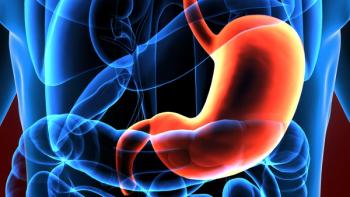
Durvalumab combined with FLOT shows significant survival benefits for patients with resectable gastroesophageal junction cancer, regardless of PD-L1 status.

Nivolumab plus chemotherapy and ipilimumab show significant long-term survival benefits for advanced esophageal squamous cell carcinoma.

Research reveals that statins and metformin enhance survival rates in early-stage triple-negative breast cancer, offering hope for affordable treatment options.

Matthew D. Clark, PharmD, highlights a pharmacist-led program that improved opioid safety in cancer care despite regulatory exemptions.

MD Anderson's opioid stewardship program enhances patient safety and care by monitoring opioid use, addressing discrepancies, and fostering multidisciplinary collaboration in cancer treatment.

In this video, experts who attended the 2025 International Myeloma Society (IMS) Annual Meeting highlighted topics of interest as well as pivotal data.

Cevostamab shows promise as a post-CAR T therapy for relapsed/refractory multiple myeloma, enhancing MRD-negative responses and improving patient outcomes.

Etentamig shows promise in managing infections for relapsed/refractory multiple myeloma.
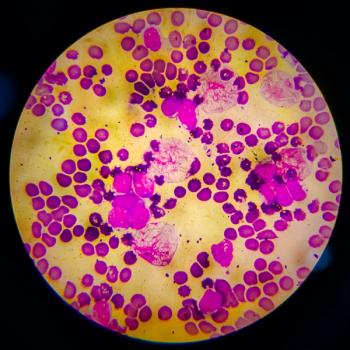
Patients with newly diagnosed transplant-eligible multiple myeloma (NDTE-MM) had high rates of complete response and minimal residual disease–negativity.

Anitocabtagene autoleucel shows impressive efficacy and safety in treating relapsed/refractory multiple myeloma, achieving a 97% overall response rate.
Xavier Leleu, MD, PhD, shares how OBI technology reduces preparation time and manual pushes for pharmacists.
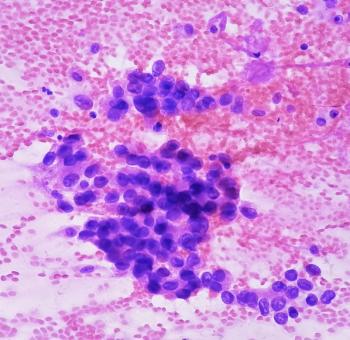
Interim trial data presented at the 2025 World Conference on Lung Cancer shows pumitamig’s promising efficacy in patients with extensive stage small cell lung cancer (ES-SCLC).
Expert shares the evolving role of pharmacy in patient care, emphasizing treatment accessibility and monitoring.
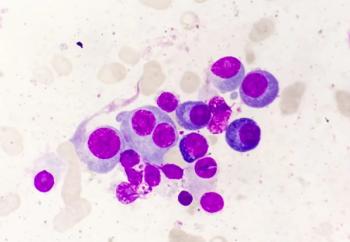
In a dose-escalation portion of LINKER-MM4, linvoseltamab monotherapy demonstrated a high overall response rate (ORR) and minimal residual disease (MRD) negativity in both transplant-eligible and transplant-ineligible patients with newly diagnosed multiple myeloma (NDMM).

New IMWG/IMS guidelines enhance risk assessment for multiple myeloma, revealing daratumumab's impact on patient outcomes in real-world settings.

New research links rapid CAR T-cell expansion to delayed neurotoxicity in patients with multiple myeloma.

Claudio Cerchione, MD, PhD, discusses the benefits of anti-CD38 quadruplet regimens for older patients with multiple myeloma.
Expert shares the promising potential of linvoseltamab in treating high-risk smoldering multiple myeloma.

Expert shares the latest advancements in CAR T therapy and novel treatments for myeloma, addressing access challenges and promising new options.

Elranatamab enhances MRD negativity in relapsed/refractory multiple myeloma post idecabtagene vicleucel, promising improved treatment outcomes.
Expert discusses groundbreaking studies on the on-body injector for isatuximab, highlighting its efficacy, safety, and patient convenience.
Pharmacists enhance patient care in multiple myeloma by focusing on infection prevention, CRS management, and optimizing outcomes with T-cell engagers post-CAR T.
Idecabtagene vicleucel shows a lower infection risk than other BCMA therapies for multiple myeloma.
Costimulatory bispecific antibodies revolutionize multiple myeloma treatment, offering deeper responses and flexible sequencing strategies for patients.

New findings reveal that combining daratumumab with lenalidomide significantly enhances MRD negativity and progression-free survival in multiple myeloma maintenance therapy.
Linvoseltamab combined with carfilzomib shows promising results in treating relapsed/refractory multiple myeloma.
Iberdomide enhances chimeric antigen receptor (CAR) T-cell therapy effectiveness in multiple myeloma, boosting immune response and cell functionality.

Experts discuss the potential of linvoseltamab in treating high-risk smoldering multiple myeloma, highlighting promising early trial results and response rates.