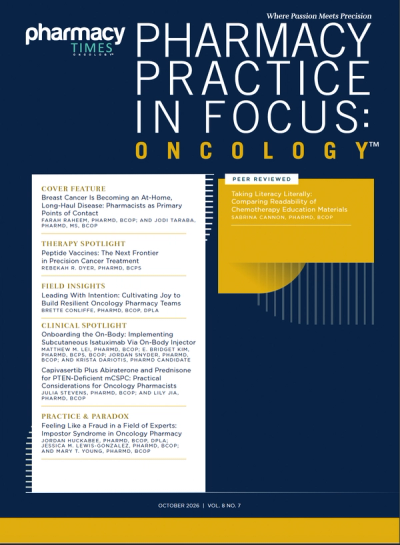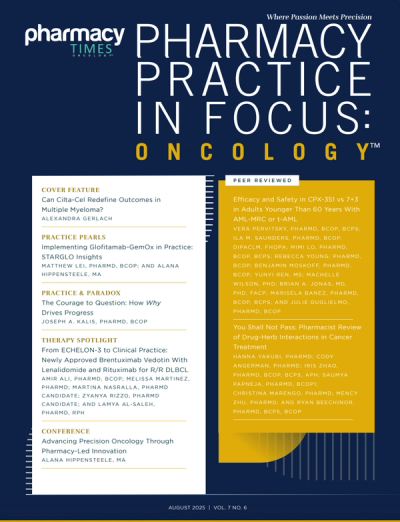
Pharmacy Practice in Focus: Oncology
Peer-Reviewed Articles
Recently Published

Oct 22, 2026 | News
Extended-Interval Tarlatamab Dosing Offers Pharmacists More Flexible Administration Windows in SCLC

Feeling Like a Fraud in a Field of Experts: Impostor Syndrome in Oncology Pharmacy
Oct 20, 2026

Capivasertib Plus Abiraterone and Prednisone for PTEN-Deficient mCSPC: Practical Considerations for Oncology Pharmacists
Oct 19, 2026

Onboarding the On-Body: Implementing Subcutaneous Isatuximab via On-Body Injector
Oct 19, 2026

Peptide Vaccines: The Next Frontier in Precision Cancer Treatment
Oct 15, 2026
Issues


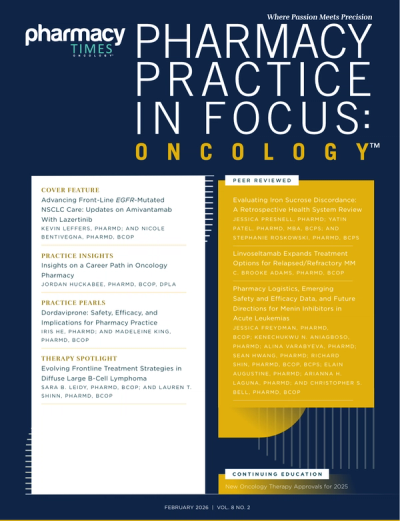
February 2026


Call for Papers

Immunotherapies, such as checkpoint inhibitors and CAR T-cell therapy, have been rapidly evolving and are a key area in the evolving landscape of oncology treatment. Researchers continue exploring novel combinations, identifying predictive biomarkers, and optimizing treatment strategies.

Oncology pharmacists work closely with oncologists to ensure that patients receive personalized treatments based on their genetic and molecular profiles. This area is evolving as new targeted therapies and biomarkers emerge.

Researchers are increasingly focused on identifying genetic and molecular biomarkers to match patients with targeted therapies. This personalized approach aims to improve treatment efficacy and reduce adverse effects (AEs).

Research is ongoing to discover and validate new biomarkers for early cancer detection, patient stratification, and treatment response predictions. This includes genomics, proteomics, and liquid biopsy technologies.

As more biosimilars become available, discussions continue around their safety, efficacy, interchangeability with reference biologics, and cost-effectiveness.

Investigating the efficacy of combining different treatment modalities, such as chemotherapy with immunotherapy or targeted therapies, is a key area of interest.

With the increasing availability of oral chemotherapy drugs, discussions continue around adherence, monitoring, and the unique challenges oral chemotherapy drugs pose compared with intravenous treatments.

Addressing the challenges of drug shortages is a persistent concern in oncology pharmacy. Oncology pharmacy professionals work to ensure continuity of care for patients despite these shortages. Sharing innovative solutions to these shortages is a key area for discussion.

Oncology pharmacists help patients manage cancer-related symptoms and improve their quality of life. This includes discussions on pain, nausea, and other AEs.

The use of AI and machine learning in clinical trial design, patient selection, and data analysis is a growing trend, enabling more efficient and precise clinical trials. Additionally, using AI in the oncology pharmacy practice setting is an opportunity for innovation.

Programs to educate and train oncology pharmacists are continuously evolving to keep up with new developments in the field.

Oncology pharmacy professionals focus on improving the safety and quality of oncology pharmacy practice, including reducing medication errors and optimizing medication management.
Submit Your Paper
Editorial Advisory Board
Advertisement
Advertisement
Advertisement
Trending on Pharmacy Times
1
Why an Oral PCSK9 Inhibitor May Motivate More LDL-C Lowering
2
GLP-1 RA Adverse Effects: What Pharmacists Should Monitor
3
FDA Approves Bacfenssi to Reduce Surgical Site Infections After Colorectal Surgery
4
One SERD, Two Settings: Giredestrant in Advanced and Early Breast Cancer
5