

At the 2026 New England Institute of Ambulatory Care Pharmacists (NEIAP) Annual Forum, Jennifer Goldman detailed how monitoring data drives engagement—and how a new dual sensor readies pharmacists for ketone alerts.

Luke Halpern is an associate editor with Pharmacy Times. Luke wrote for Pharmacy Times in the summer of 2023 and assumed a full-time role in June 2024. His work has been featured in Pharmacy Times and the American Journal of Managed Care. He graduated from the University of Massachusetts, Amherst, in May 2024.
At the 2026 New England Institute of Ambulatory Care Pharmacists (NEIAP) Annual Forum, Jennifer Goldman detailed how monitoring data drives engagement—and how a new dual sensor readies pharmacists for ketone alerts.

Vicki Saengkheune, PharmD, and Bola Olagunju, PharmD, describe a collaborative clinic where pharmacists titrate therapy, counsel, and remove access barriers.

Apitegromab-mstn is cleared as an add-on to SMN2-targeted treatment for patients aged 2 and older, directly addressing muscle loss.

Jackie Burke, PharmD, has advice for strengthening collaborative drug therapy management (CDTM) in a year: ask leaders what they need, then pilot one focused, trackable, reportable workflow.

Jackie Burke, PharmD, says the widest collaborative drug therapy management (CDTM) gap is operational—implementing workflows and showing outcomes, not proving pharmacists' clinical expertise.
The strongest antiobesity medication candidates are chosen by overall health and comorbidities like heart failure, CKD, and sleep apnea, not weight alone.

Katelyn O'Brien, PharmD, says a shared view of cardio-kidney-metabolic syndrome lets pharmacists unify care across endocrinology, cardiology, and nephrology.

Kelsey Norman, PharmD, says pharmacists' longer visits and collaborative practice agreements make them well positioned to get patients to low-density lipoprotein (LDL) goals.

Anthony Ishak, PharmD, explains how the PREVENT risk estimator helps pharmacists calibrate dose intensity and move stage 2 patients to combination therapy.

The DAPA ACT HF-TIMI 68 analysis shows early, sustained congestion relief and rising diuretic efficiency through 2 months.

Camizestrant is the first cancer therapy guided by a ctDNA resistance mutation detected before imaging shows disease progression.

The Cleveland Clinic team's real-world findings presented at ESC 2026 are hypothesis-generating and need prospective confirmation but point to a low threshold for OSA screening.
Publication, conference dissemination, and guideline inclusion are needed for uptake, which has historically been poor for chronic kidney disease (CKD) outcome sets.

A single-center study found similar 12-month total weight loss whether or not patients used a glucagon-like peptide-1 (GLP-1) receptor agonist before surgery.

Milind Desai, MD, MBA, explains the domino effect linking obesity, obstructive sleep apnea, and hypertrophic cardiomyopathy—and why treating obesity may break the chain.

A prespecified analysis found the PCSK9 inhibitor reduced total events 20% in high-risk patients with no prior heart attack or stroke.

Zilganersen, an antisense oligonucleotide targeting glial fibrillary acidic protein, is cleared for pediatric and adult patients across all ages.

A real-world analysis of matched adults links glucagon-like peptide-1 (GLP-1) receptor agonist use to fewer major cardiovascular events, driven by a mortality benefit.
A minimum agreed set of outcomes could let pharmacists compare chronic kidney disease (CKD) interventions head-to-head and cut the heterogeneity that has long muddied trials.

Five "essential" outcomes, including medication error and adherence, should anchor every pharmacist intervention study in chronic kidney disease.
Glucagon-like peptide-1 (GLP-1) and GIP/GLP-1 agents are just the start: amylin- and glucagon-based mono-, dual-, and tri-therapies are on the horizon.

A multicohort study finds divergent complication patterns and raises the prospect that millions are being treated for the wrong mechanism.

Pharmacists’ medication expertise can mitigate GI adverse effects and improve outcomes for patients beginning obesity pharmacotherapy

A Medicare GLP-1 bridge program marks 2026, while multiagonists like CagriSema are poised to lead the next wave of obesity therapy.
Rusfertide gives adults with polycythemia vera a first-in-class option to cut phlebotomy dependence and control hematocrit.
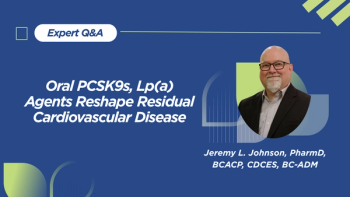
From enlicitide to Lp(a)-lowering siRNAs, a look at the add-on therapies helping high-risk patients reach stricter LDL targets below 55 mg/dL.

Pharmacist Jennifer Goldman on why expectation-setting, GI counseling, and nutrition drive glucagon GLP-1 persistence and long-term success.
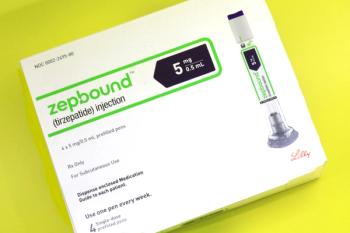
Real-world data show sustained tirzepatide use offset its cost by 12 months in adults older than 55 years, with fewer hospital and ED visits.
Mounjaro becomes the first GIP/GLP-1 receptor agonist cleared to lower MACE risk, based on the SURPASS-CVOT head-to-head trial.
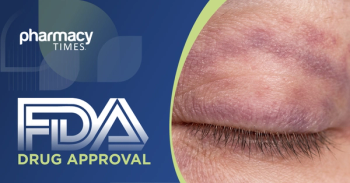
Brepocitinib (Lisraya), a once-daily TYK2-JAK1 inhibitor, is the first oral therapy approved for adults with the rare autoimmune disease.
Published: August 25th 2026 | Updated: September 4th 2026
Published: August 28th 2026 | Updated: August 31st 2026
Published: August 26th 2026 | Updated: August 27th 2026
Published: August 25th 2026 | Updated: August 27th 2026

Published: August 20th 2026 | Updated: August 21st 2026

Published: August 7th 2026 | Updated: August 10th 2026