

Explore the long-term effects of myelofibrosis and the importance of early diagnosis and treatment for better patient outcomes.

Zahra Mahmoudjafari, PharmD, MBA, BCOP, FHOPA, is Pharmacy Practice in Focus: Oncology editor-in-chief and a clinical pharmacy manager in the Division of Hematologic Malignancies and Cellular Therapeutics at the University of Kansas Health System in Kansas City, Kansas.
Explore the long-term effects of myelofibrosis and the importance of early diagnosis and treatment for better patient outcomes.
Explore the critical role of patient characteristics and biomarker testing in managing myelofibrosis, enhancing prognosis and treatment strategies.
Oncology pharmacists discuss myelofibrosis management, focusing on anemia, JAK inhibitors, and improving patient outcomes through tailored care.
Explore expert insights on managing myelofibrosis, focusing on anemia, JAK inhibitors, and enhancing patient care for better outcomes.

Oncology pharmacy evolves rapidly, emphasizing the need for pharmacists to stay informed and reflect on personal growth for better patient care.


August marks a pivotal time for oncology pharmacy, blending transitions, celebrations, and new beginnings as professionals prepare for the upcoming season.

Panelists discuss how advancing chronic graft-vs-host disease (cGVHD) management involves improving steroid response rates, exploring combination therapies, utilizing biomarkers for personalized treatment, and striving for steroid-free first-line options to enhance patient outcomes and reduce long-term adverse effects.
Panelists discuss how collaboration between pharmacists and health care providers is essential for optimizing treatment outcomes in chronic graft-vs-host disease (cGVHD), emphasizing the importance of education, symptom management, and a multidisciplinary approach to ensure comprehensive, patient-tailored care.


Zahra Mahmoudjafari, PharmD, MBA, BCOP, FHOPA, co-chair of the 2025 Oncology Pharmacists Connect (OPC) meeting, discusses what makes the event unique, highlights key sessions, and shares her excitement for the educational and networking opportunities.
Panelists discuss how pharmacists improve patient outcomes in chronic graft-vs-host disease (cGVHD) by addressing accessibility and tolerability challenges, optimizing drug regimens, managing adherence, and fostering trust with patients to ensure consistent therapy and long-term success.
Panelists discuss how pharmacists are essential in managing chronic graft-vs-host disease (cGVHD) by addressing challenges like toxicity, financial and logistical barriers, and a lack of awareness, while advocating for patient education, collaboration with health care teams, and ensuring access to necessary therapies.
Panelists discuss how evolving treatment pathways at Emory Healthcare, including earlier use of emerging therapies and off-label combination treatments, are shaping the management of chronic graft-vs-host disease (cGVHD), with an emphasis on personalizing therapy based on real-world data and patient-specific factors.
Panelists discuss how factors such as patient preferences, disease severity, organ-specific involvement, and adverse effect profiles influence the selection of second-line therapies for steroid-refractory chronic graft-vs-host disease (cGVHD) in the context of multiple FDA-approved agents.
Panelists discuss how factors such as patient preferences, disease severity, organ-specific involvement, and adverse effect profiles influence the selection of second-line therapies for steroid-refractory chronic graft-vs-host disease (cGVHD) in the context of multiple FDA-approved agents.
Panelists discuss how recent FDA approvals and evolving evidence for second-line treatments, including ruxolitinib, ibrutinib, and belumosudil, are reshaping chronic graft-vs-host disease (cGVHD) management by offering tailored, evidence-based options for steroid-refractory patients.
Panelists discuss how second-line therapy selection and individualized care strategies are essential in chronic graft-vs-host disease (cGVHD) management, emphasizing the need to reduce steroid-related toxicity, address patient-specific factors, and leverage pharmacist expertise to optimize outcomes.
Panelists discuss how early diagnosis, evolving treatment strategies, and pharmacist-led interventions are advancing chronic graft-vs-host disease (cGVHD) management by addressing unmet needs, improving care coordination, and enhancing patient access to emerging therapies.

Zahra Mahmoudjafari, PharmD, BCOP, FHOPA, shared insight from the HOPA Annual Meeting 2025.

Metrics should empower pharmacists rather than burden them.

Pharmacists are essential navigators in the complex landscape of gene therapy.
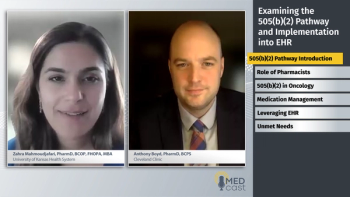
A panelist discusses how the 505(b)(2) regulatory pathway provides a streamlined approval process for modified versions of previously approved drugs, allowing pharmaceutical companies to rely partly on existing safety/efficacy data while still requiring new clinical data, commonly used across various therapeutic areas including reformulations, new dosage forms, and drug combinations.

Pharmacists bring a unique perspective to health care that bridges clinical knowledge, patient-centered care, and operational expertise.

The panel discussion concludes with final thoughts on the future landscape of newly diagnosed multiple myeloma.
Panelists discuss how pharmacists can address remaining unmet needs and challenges in optimizing frontline therapy for patients with transplant-eligible newly diagnosed multiple myeloma (NDMM), including areas such as managing complex drug interactions, improving medication adherence, mitigating treatment-related toxicities, streamlining transitions of care, and enhancing patient education and support throughout the treatment journey.
Panelists discuss how they navigate challenges with payer coverage for quadruplet regimens in multiple myeloma treatment, including strategies they employ to address insurance denials or restrictions, such as providing clinical justification, leveraging recent trial data, and collaborating with financial assistance programs to ensure patients can access optimal therapy despite potential coverage difficulties.
Panelists discuss how treatment regimens for multiple myeloma patients can be personalized to improve adherence and quality of life by considering factors such as dosing schedules and routes of administration while emphasizing the role of pharmacists in providing resources and support to keep patients informed, engaged, and compliant with their individualized treatment plans.
Panelists discuss how pharmacists actively engage in educating and coordinating with nurses, oncologists, and other health care providers by conducting in-service trainings, participating in multidisciplinary team meetings, and collaborating on the development and implementation of formularies, order sets, and treatment protocols to ensure optimal patient care in multiple myeloma management.