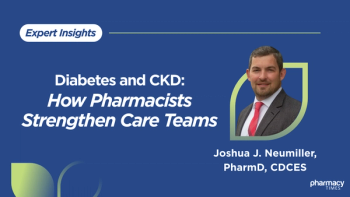
Joshua J. Neumiller, PharmD, CDCES, of the American Diabetes Association discusses pharmacists’ role in diabetes and CKD care from ASN Kidney Week 2026
Andrew Shao, PhD, senior vice president for global regulatory and scientific affairs at Niagen Bioscience, discusses how increased consumer access to information has shifted the supplement landscape toward greater demand for clinically validated products and transparency. He highlights the critical role pharmacists play in guiding consumers toward evidence-based supplements, while emphasizing the need for stronger regulatory enforcement and industry accountability to improve trust and product quality.
Pharmacy Times: The global supplement market is increasingly shifting away from brand-driven wellness claims toward clinically validated products. From your perspective, what key forces—regulatory, scientific, or consumer-driven—are accelerating this transition, and how has Niagen Bioscience positioned itself to lead in this new environment?
Andrew Shao, PhD: I think this is a very interesting question. Consumers have gotten more savvy, and partially it's just that there's so much more information available at their fingertips. You know, 20 or 30 years ago, when a study was published, it would go through this filtration process—scientists, scientific meetings, and so forth. But today, something gets done, maybe it isn't even peer reviewed or published. A company does a study, it gets out there, and it gets right to the consumer right away.
So they have access to a lot more science, much sooner and much faster than they did before. And there's so much information—there's AI [artificial intelligence]. So consumers are becoming more savvy, and they can be more selective about what they choose to use. And so I think that may be a force behind consumers moving away from what you're saying—wellness claims—toward things that are clinically validated.
The way we've inserted ourselves into that is to maintain what we think is an industry-leading external research program where we work with investigators, but they publish independent studies. In other words, they're independent of us. We provide the material, for example, for them to do studies—whether it's preclinical or clinical studies—but they design the studies, they execute the studies, and they publish the studies. We provide some input, but we don't control it, so it's really independent.
And we think that level of independence carries, or should carry, a lot more credibility and trust with practitioners, but consumers as well. So there are some challenges in there, in that there's misinformation that influencers get hold of. Maybe it's not legitimate science, and they can promote bad science, and maybe the consumer doesn't necessarily know what's bad science from good science. So that's a challenge that we have now with the information age, with so much information coming at folks.
Pharmacy Times: From a pharmacist’s perspective, recommending or even discussing supplements with patients can be challenging due to variability in quality and evidence. How does Niagen’s clinical research approach help pharmacists feel more confident when counseling patients about NAD+ precursors and longevity-focused supplementation?
Shao: You know, it's a challenge to navigate this industry. You go to a retail outlet—maybe a pharmacy—and it's a wall of products. The consumer is confronted by that, the pharmacist is confronted by that, and it's a challenge for the pharmacist because they're one of the leading go-to resources for consumers. As you know; I don't have to tell you that.
So what do you do as a pharmacist? We know, as a responsible company in this industry, that we're on an unlevel playing field. All these brands on the shelf look the same. They all tout themselves as being superior—third-party tested, endorsed, clinically everything. Nobody's going to say that we're not well studied or that we don't have a quality product. So how do you decide?
I think this goes back to a couple of things. One is our external research program. Think about it—if you're a pharmacist and you've got to recommend a product to your patient or to a consumer, wouldn't it give you confidence to know that the actual product you would recommend is cited in top-tier, high-impact peer-reviewed journals? It's actually mentioned in there, so the product you're going to have someone or their family member ingest is the one that was studied.
In our case, that includes more than 40 peer-reviewed, published clinical trials. Those studies either say the word Niagen in them—Niagen was tested—or they refer to our company because we provided the material. It's the same material that you would ingest or have your family member take if you were advising them to use Tru Niagen. Very few supplement products can claim that.
If you wanted that trust and validation as a pharmacist, you could look for that in those studies and know that what was actually tested is what you're going to be ingesting, which is rare in the supplement space. The other things, of course, are common things that a pharmacist would look for, such as third-party certification. We are very much invested in that with third parties such as NSF, and there's a new one called Supco. We're even working very closely with USP [United States Pharmacopeia], which is a standard-setting organization that you know well, and I'm sure pharmacist practitioners have a lot of trust and faith in USP.
These are the gold-standard organizations that we align ourselves with. Those are a couple of things that we do that we think should give pharmacists confidence in our product. And if they can find others that do that, by all means, recommend those as well—but those are few and far between.
Pharmacy Times: As regulatory scrutiny of dietary supplements continues to increase, particularly around labeling, claims, and manufacturing standards, how do you see the regulatory landscape evolving over the next 3 to 5 years, and what role should science-focused companies play in shaping responsible industry standards?
Shao: Well, I might take issue with the first part of your question because I don't know that it has increased. I think that maybe some of the regulations have evolved and modernized. You have good manufacturing practices now. You have mandatory adverse event reporting, right? But it's the enforcement that's falling short.
So the analogy that we have is we've put speed limit signs up all over the place to try to keep people from speeding, but then we haven't funded the police department. We've pulled back on the funding of the police department, so there are no cops, or there are not enough cops doing their job. So we have plenty of speed signs, but no cops, and I think that's the issue here.
We have some good regulations in place around manufacturing standards—GMP [Good Manufacturing Practices] and adverse event reporting—but the FDA doesn't have the resources it needs to properly enforce those. Companies like ours are trying to do a couple of things. One is to advocate for more resources for the agency. We do that through our trade association partners like CRN [Council for Responsible Nutrition].
The other thing is to try to go beyond that and encourage other responsible companies to come together, pool our resources, and maybe help pull the curtain back a little bit. On some of these e-commerce platforms, for example, it's kind of like the Wild West, with products and brands popping up all the time that really aren't delivering on their promises.
We know this because we maintain a surveillance program that goes out, pulls products, and tests them. It's almost helping the FDA with its job, essentially. We've found some pretty egregious things, like empty capsules—consumers purchasing products off of Amazon, for example, that have nothing in them. Empty capsules, if you can believe that.
So, what we're trying to do is give visibility to this and try to attract other like-minded companies to join this effort as a way to try to level the playing field and actually improve trust. Although the regulations are there, the enforcement is not.
Pharmacy Times: Pharmacists are increasingly viewed as trusted gatekeepers for evidence-based self-care and wellness products. How can pharmacy teams evaluate which supplement brands truly meet scientific and regulatory standards, and what criteria should guide their recommendations to patients?
Shao: I think I alluded to this in a previous answer. One is to try to recommend those brands that you trust, and the trust comes from the investment that the company or the brand makes. You can see that from things like peer-reviewed, published studies that are conducted on the actual product and third-party certification or validation.
Another thing that we do is make our certificates of analysis—COAs—available to consumers or pharmacists right on our website. You can look up the lot number of a product and see whether it passed and what all the numbers are, and so forth.
These are a couple of ways to get some insight into whether a product is truly legitimate and has made the investment in quality and science that warrants a recommendation from a pharmacist.
Pharmacy Times: Transparency has become a central concern for consumers, retailers, and clinicians alike. How do patents, clinical trial data, and third-party verification help build credibility, and what steps is Niagen taking to make scientific evidence more accessible and understandable to nonspecialist audiences?
Shao: That's an excellent question. I think that what all of these collectively do is show how much we are investing in our consumers' health. We have as much interest in furthering their health as they do. We're partners in that. We're not looking to profit off of them—we're looking to partner with them.
The patents we have, I think just in and around the Tru Niagen product, there are over 60 patents. I mean, that's an enormous investment and one that you don't see in the supplement industry these days. As I mentioned, there are more than 40 clinical trials published, with many more on the way—over 30, it's 37 that are still in process. I mean, this is unprecedented.
We invest in organizations like NSF and USP. One of the steps that we've taken is to help support this third-party website called aboutnad.com. That's where a consumer, investor, or pharmacist could go and view all of the studies that have been published—preclinical and clinical. There are educational resources with background information, learning about our product and what it is.
NAD is a coenzyme. Our product is a precursor of the coenzyme—a building block of it. It gets a little complicated, but all of that is laid out there and it is routinely updated. There are blogs, so that's a resource that we support to try to bring that education out.
We also participate in a lot of different events—scientific events and health care practitioner events. We work closely through trade association partners like CRN, and we're also very active in the American Society for Nutrition as well. So, we're quite a lean organization, but we're trying to push out the education to different audiences in many different ways.
Pharmacy Times: From a pharmacist and health care professional perspective, integrating supplements into patient care requires confidence in safety, efficacy, and consistency. How can pharmacists leverage clinically validated nutraceuticals in patient counseling, and what role do you see pharmacists playing in elevating standards across the longevity and wellness space?
Shao: The latter part first. I think pharmacists are critical—maybe even more so than primary care physicians. I think pharmacists have more interaction with consumers, typically more frequent and probably longer than a physician does. A physician is like, you know, get them in, get them out, get them in, get them out. And frankly, many physicians don't have any nutrition training at all. Maybe they had a day of it in medical school. So they know nothing about nutrition and very little about supplements. And if they ask about supplements, it's probably viewed in a negative way.
So pharmacists become a very important, kind of neutral, objective source of information for consumers. Because pharmacists are so heavily relied on, they can play a very pivotal role in helping to level the playing field. Consumers can't tell who is investing in their health and who is just trying to make a buck, especially if they are swayed in any way by influencers, which many are.
So I think the pharmacist has to step in and be an educational resource for consumers. Pharmacists can talk to consumers about the very things that I've mentioned here—what consumers have to look for. I think pharmacists should also take up a lobbying role and lobby Congress regarding the law that we've operated under for over 30 years. It's outdated and needs to be modernized.
Pharmacists can play a role in pushing for higher standards—something that we would very much welcome—around things like transparency. The FDA doesn't know all the products that come on the market because the law doesn't require companies to tell them. So, the agency has no idea; they play catch-up with enforcement.
There's an effort to try to increase transparency by requiring companies to list their products with the FDA—something we support very strongly, and CRN supports very strongly. It would be great if the pharmacy lobby would support that as well and push very hard for it. That's a very simple step that would make the whole industry a lot more transparent to the FDA.
So, in addition to educating consumers, pharmacists should become active in advocating for greater enforcement and perhaps policy reform. We've got an outdated law here that needs some tweaks. I think that is something they should do much more of.