
Explore effective non-hormonal treatment options for menopause-related vasomotor symptoms, including hot flashes and night sweats, with insights from pharmacists.
Explore effective non-hormonal treatment options for menopause-related vasomotor symptoms, including hot flashes and night sweats, with insights from pharmacists.
Explore the promising data on elinzanetant for managing menopause-related vasomotor symptoms, highlighting its tolerability and minimal side effects.


Samantha Picking, PharmD, highlights pharmacists’ leadership in immunization initiatives, public health collaborations, and the evolving role of community pharmacy in preventive care.
Megan Dulohery Scrodin, MD, highlights Mayo Clinic's innovative COPD care model, emphasizing multidisciplinary collaboration and AI tools for improved patient outcomes.

Experts discuss breakthroughs in respiratory virus vaccines.
Elinzanetant shows promise as a new treatment for menopause-related vasomotor symptoms, offering rapid relief and a favorable safety profile.

Panelists discuss the long-term safety and durability of CDK4/6 inhibitors, highlighting data supporting sustained efficacy and manageable toxicity over years of treatment.

Panelists discuss how differences in dosing schedules, adherence challenges, and total duration of CDK4/6 inhibitor therapy impact patient management, treatment decisions, and quality of life in both advanced and early-stage settings.
Panelists discuss best practices for patient education and engagement when introducing CDK4/6 inhibitors in metastatic breast cancer care.
Panelists discuss how dose reductions for CDK4/6 inhibitors are commonly needed due to neutropenia, thrombocytopenia, diarrhea, and other toxicities but do not compromise efficacy based on subgroup analyses from major trials, while dose escalation strategies (particularly starting abemaciclib at 50 mg and gradually increasing) have been successfully implemented based on the TRADE study data to reduce early discontinuation rates by approximately 50%, though practical challenges exist with pharmacy dispensing and patient questions about why escalation to full dose is necessary when lower doses maintain efficacy.

Research reveals varying impacts of GLP-1 receptor agonists on asthma risk, urging careful medication selection for patients with diabetes and respiratory issues.
Explore how pharmacists can better support indigenous and Hispanic women during menopause through culturally sensitive care and family involvement.

A digital therapeutic app enhances access to behavioral cough suppression therapy.

James Chalmers, MBChB, PhD, discusses the ASPEN trial's findings on brensocatib's impact on lung structure and function in bronchiectasis patients.
Megan Dulohery Scrodin, MD, discusses COPD management challenges and the need for accessible care and cost reduction.
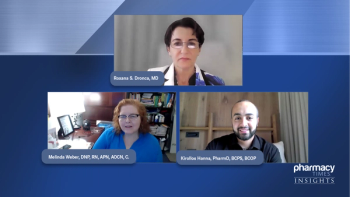
Panelists discuss how subcutaneous administration enhances patient satisfaction by reducing venipuncture trauma and wait times, creates cost savings through eliminated IV supplies and shortened chair occupancy, enables higher infusion center throughput, and garners strong nursing support due to reduced patient distress during administration.
An expert discusses how improving shingles vaccination rates relies on patient education; effective use of technology like EHRs to identify eligible individuals; and persistent, multichannel communication by pharmacists to encourage vaccination and address barriers such as cost and awareness.
An expert discusses how low shingles vaccination rates stem from gaps in patient education, cost concerns, and access barriers, emphasizing that clear communication about vaccine efficacy, reduced out-of-pocket costs, and targeted outreach are key to increasing uptake, especially among older and rural populations.
Panelists discuss how implementing subcutaneous checkpoint inhibitors requires navigating temporary J-codes and reimbursement delays, considering economic impacts on institutional revenue streams, building indication-specific electronic treatment plans, and adopting provider-driven rather than mandated prescribing approaches while anticipating future dynamics including biosimilar competition and Inflation Reduction Act implications.
Subcutaneous amivantamab demonstrated robust activity in patients with recurrent or metastatic head and neck squamous cell carcinoma previously treated with checkpoint inhibitors and platinum chemotherapy.
The combination significantly improved event-free and overall survival compared with surgery alone, marking the first study to show an overall survival benefit in this patient population.
The phase 3 trial demonstrated significant improvements in overall and progression-free survival, reinforcing the combination as a standard-of-care option across MMR subgroups.

Sara Assaf, MD, shares insights on selecting biologic therapies for severe asthma, including biomarkers, patient factors, and managing nonresponders effectively.

The FDA's approval of GLP-1 for obstructive sleep apnea enhances treatment options, emphasizing pharmacists' vital role in patient care and management.
Panelists discuss how the MK-3475A-D77 trial demonstrated subcutaneous pembrolizumab’s pharmacokinetic comparability and equivalent efficacy to IV formulation in patients with metastatic non–small cell lung cancer receiving combination chemotherapy, with administration requiring approximately 2 minutes for 5 mL volume and showing comparable safety profiles.
Panelists discuss how the IMscin001 trial established subcutaneous atezolizumab’s pharmacokinetic equivalency to IV formulation with comparable efficacy and 4.5% injection site reactions, while highlighting operational implementation challenges, including building multiple indication-specific order sets and standardizing varying administration times across different subcutaneous products.
Panelists discuss how subcutaneous nivolumab demonstrates reassuring safety profiles with minimal grade 3 and 4 adverse events comparable to those of IV formulation, produces pharmacokinetically equivalent or slightly higher drug exposure, and shows numerically similar or higher objective response rates, making patient education about injection site reactions the primary consideration.
Panelists discuss how the CheckMate67T trial demonstrated pharmacokinetic noninferiority and comparable efficacy and safety between subcutaneous and IV nivolumab, with subcutaneous administration requiring only 3 to 5 minutes vs 30-minute infusions and showing mild, transient injection site reactions in approximately 8% of patients.