
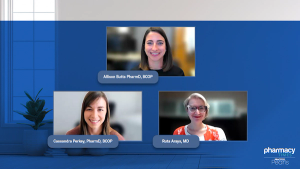
Cassandra Perkey, PharmD, BCOP, explains the operational, staffing, infrastructure, safety, and pharmacist-led requirements for successfully delivering CAR T-cell therapy in a community oncology setting.
Cassandra Perkey, PharmD, BCOP, explains the operational, staffing, infrastructure, safety, and pharmacist-led requirements for successfully delivering CAR T-cell therapy in a community oncology setting.
Cassandra Perkey, PharmD, BCOP, discusses how pharmacists support community CAR T-cell programs through SOP development, treatment planning, education, emergency preparedness, and lessons learned from treating the first patient.
In an interview with Pharmacy Times, Cassandra Perkey, PharmD, BCOP, explains the staffing, infrastructure, hospital partnerships, and scheduling strategies needed to safely deliver outpatient CAR T-cell therapy in a community oncology setting.
In an interview with Pharmacy Times, Cassandra Perkey, PharmD, BCOP, outlines the essential teams, SOPs, financial planning, and safety protocols community oncology practices need to launch outpatient CAR T-cell therapy successfully.
This final segment consists of expert clinicians offering key takeaways to help pharmacists prepare for potential approvals and integrate new TNBC therapies into practice.
This segment summarizes early DB-1305 data showing promising efficacy and manageable toxicity in pretreated TNBC, along with ongoing investigation of combination strategies such as anti-PD-L1 × VEGF bispecific therapy.
If datopotamab deruxtecan (Dato-DXd) is approved for first-line metastatic TNBC, it could significantly influence clinical practice by providing an effective option for patients, particularly those ineligible for immunotherapy or with PD-L1–negative disease.
Pharmacists play a critical role in educating patients about potential side effects, monitoring for early signs of toxicity, and coordinating supportive care measures, including growth factor support for hematologic events.
Studying antibody–drug conjugates (ADCs) in patients ineligible for immunotherapy addresses a critical unmet need in PD-L1–negative metastatic TNBC, where targeted treatment options are limited.
If sacituzumab govitecan (SG) is approved for first-line metastatic TNBC, it could meaningfully shift clinical practice by providing an effective option for patients ineligible for immunotherapy or with PD-L1–negative disease.
Because ASCENT-03 allowed crossover and more than half of patients received subsequent therapy, overall survival is unlikely to show a statistically significant difference, even if a clinical benefit exists.
The ASCENT-03 trial, presented at ESMO and published in NEJM, evaluated sacituzumab govitecan (SG) versus physician’s-choice chemotherapy—including paclitaxel, nab-paclitaxel, or gemcitabine/carboplatin—in patients with metastatic TNBC who were either PD-L1–negative or not candidates for immunotherapy.
If SG plus pembrolizumab becomes approved in the first-line metastatic TNBC setting, many clinicians anticipate shifting practice patterns to favor this regimen, given its promising efficacy.
From a pharmacologic standpoint, the adverse events associated with sacituzumab govitecan (SG)—particularly neutropenia and diarrhea—are consistent with the mechanism of its payload.
In clinical practice, the approach to G-CSF use with sacituzumab govitecan (SG) is typically individualized based on patient-specific risk factors and prior tolerance.
This section compares the adverse-event patterns of SG plus pembrolizumab versus chemotherapy plus pembrolizumab, emphasizing differences in hematologic and non-hematologic toxicities that inform clinical monitoring.
This segment explains how ASCENT-04 assessed whether moving sacituzumab govitecan into the first-line setting with immunotherapy could improve outcomes for a population with historically limited options.
This segment summarizes the challenges of metastatic TNBC and highlights how current treatment decisions rely on biomarkers and evolving molecular profiling to guide a personalized therapeutic approach.

Peer Reviewed
Artificial intelligence holds immense potential to address the rising demand for oncology services and improve patient outcomes by facilitating more effective, efficient, personalized cancer care.

Peer Reviewed
Persistent chemotherapy drug shortages challenge oncology providers. American Oncology Network employs a drug shortage committee for organized shortage management that involves pharmacists and interdisciplinary stakeholders.
October 15th 2025
November 26th 2025