Now Playing
Oncology pharmacists Mitchell Blewett and TJ Schieber explain how non-muscle-invasive bladder cancer is diagnosed and risk-stratified, and why recurrent low-grade, intermediate-risk disease carries a heavy cumulative burden despite low mortality.
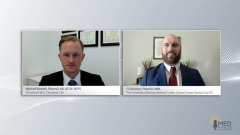
Welcome to this Pharmacy Times MEDCast series. In this episode, titled ‘Understanding Recurrent LG-IR-NMIBC: Patient Population and Risk Stratification,’ Mitchell Blewett, PharmD, MS, BCOP, BCPS, oncology manager of pharmacy services at Cleveland Clinic, and TJ Schieber, PharmD, MBA, oncology pharmacy specialist at The University of Kansas Medical Center Cancer Center, set the stage for pharmacists who may have limited exposure to bladder cancer. Blewett explains that roughly 75% of patients with bladder cancer present with non-muscle-invasive disease—typically older adults and more commonly men—with tobacco exposure as the most significant risk factor and painless hematuria as the classic presentation. Because these patients are managed primarily by urology, oncology pharmacists have historically become involved only around the first intravesical treatment.
Schieber describes the detrusor muscle as the critical dividing line between non-muscle-invasive and muscle-invasive disease, one that shapes tumor biology, prognosis, and treatment intent. The pharmacists then walk through how tumor grade, size, number, and recurrence history determine low-, intermediate-, or high-risk classification, emphasizing that risk should be reassessed with every recurrence.
Schieber closes by outlining the recurrence pattern of low-grade, intermediate-risk disease, in which recurrences tend to come faster over time. For these patients, the true burden is not cancer-specific mortality but lifelong cystoscopy, repeat trips to the operating room, cost, time away from work and family, and anxiety about what comes next.
In the next episode, ‘Beyond Repeat TURBT: Where Primary Chemoablation Fits in Recurrent LG-IR-NMIBC,’ the pharmacists will contrast the management of high-grade and low-grade disease and discuss where nonsurgical chemoablation fits in the treatment landscape.