In an interview with Pharmacy Times, City of Hope researchers discuss a preclinical platform designed to redirect CAR T cells after infusion and how pharmacists could help bring this adaptable approach into clinical practice.
Pharmacy Practice in Focus: Oncology
The innovation that frees a patient from the infusion chair is the innovation that asks pharmacists to replace, from a distance, everything that chair used to catch.
There is a moment in the IRAKLIA trial (NCT05405166) data that pharmacists keep coming back to: A subgroup of patients self-administered the isatuximab on-body injector at home. And their outcomes held up against those of patients who came into the infusion center. Although the device isn’t approved for home use, the fact that it worked just as well when nobody in scrubs was in the room says something worth sitting with.
Part of what makes that plausible is what is actually happening under the hood. The formulation is hyaluronidase-free and delivered as a fixed dose via a device that controls pressure and flow rate automatically, adjusting to the patient’s tissue rather than requiring a clinician to manage the push. It is a small engineering detail, but it is the reason a wearable injector can do reliably what used to require a trained hand in the room. The technology got quietly good enough to make the question of where treatment happens a real one, not just a convenience pitch.
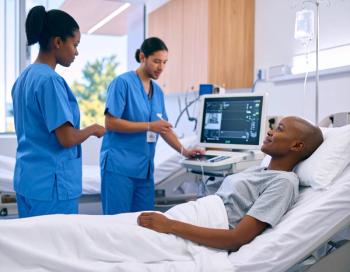
For a long time, the infusion chair has doubled as more than a delivery point; it has been a checkpoint. Someone watching for a reaction, someone available to answer “Is this normal?” in the moment, someone tracking whether a dose actually happened. An on-body injector, wearable and hands-free, quietly removes the chair from that equation without removing the need for anything the chair used to catch.
Which is really the story here. Oral chemotherapy taught oncology this lesson once already: Capability and willingness are not the same as adherence, and adherence does not happen by default simply because a patient is at home rather than at the clinic. It happens because someone builds the scaffolding for it: check-ins, clear escalation paths, a fast answer to “Should I be worried about this injection site?” before it becomes something worse. That scaffolding used to live inside the clinic visit. With a device like this, it has to be built on purpose, in advance, by someone.
Patient education carries more weight in this model too. Understanding the device, the drug, and the specific things to watch for is no longer a nice-to-have; it is the thing standing in for the supervision that used to happen automatically. And there is a workflow side worth naming honestly: Fewer patients cycling through the infusion suite for this particular therapy changes staffing and scheduling in ways that ripple beyond any one practice.
This device does not change oncology on its own. Rather, it is a clear, concrete example of a pattern: treatment getting easier to deliver at exactly the same rate that watching over it gets harder. That is the catch-22 sitting underneath all of this. The same innovation that frees a patient from the infusion chair is the innovation that asks pharmacists to replace, from a distance, everything that chair used to catch.
Stay informed on drug updates, treatment guidelines, and pharmacy practice trends—subscribe to Pharmacy Times for weekly clinical insights.
Subscribe