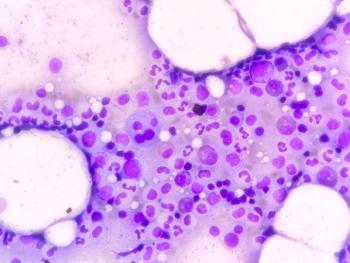
An MRD-guided strategy incorporating teclistamab-daratumumab intensification produced deep responses in newly diagnosed high-risk multiple myeloma, although infections affected more than three-fourths of treated patients.

In an interview with Pharmacy Times, Jose Bazan, MD, who leads the Breast Radiation Oncology program at City of Hope, discusses an ongoing phase 2 trial evaluating whether stereotactic body radiation therapy (SBRT) can help patients with oligoprogressive estrogen receptor (ER)-positive metastatic breast cancer remain on their current systemic therapy longer.
In an interview with Pharmacy Times, Jose Bazan, MD, who leads the Breast Radiation Oncology program at City of Hope, discusses an ongoing phase 2 trial evaluating whether stereotactic body radiation therapy (SBRT) can help patients with oligoprogressive estrogen receptor (ER)-positive metastatic breast cancer remain on their current systemic therapy longer.
Bazan distinguishes oligoprogressive disease from oligometastatic disease. Patients with oligometastatic breast cancer have a limited number of metastatic lesions overall. In oligoprogressive disease, patients may have numerous metastases, but only a few are growing or newly appearing while the remaining disease stays controlled by systemic therapy. The trial investigates whether ablating those progressing lesions can delay the need to switch medications.
Eligible patients had ER-positive metastatic breast cancer with 1 to 4 progressing lesions and were receiving one of their first 3 lines of systemic therapy. The treatment strategy targeted all progressing lesions. Patients with HER2-positive disease could participate if their tumors were also ER-positive. Bazan explains that the ER-positive requirement also supports the study’s use of FES PET imaging to assess estrogen receptor activity.
The trial uses a Simon two-stage design, with an initial enrollment of 8 patients and a planned expansion to 18 if the first stage meets its prespecified threshold. The primary outcome assesses whether patients can remain on the same systemic therapy for at least 6 months after SBRT, with a target rate of at least 50%.
Among the first 8 patients, 4 remained on their current therapy for at least 6 months. This exceeded the requirement of 2 patients needed to proceed to the second stage. Bazan notes that enrollment has expanded, with 1 additional patient enrolled at the time of the interview. Presented in ASTRO’s trials-in-progress section, these preliminary findings support continued investigation; they do not establish a definitive benefit or demonstrate improved overall survival.