





Multiple Myeloma
Latest News
Advertisement
Latest Videos

CME Content






















Advertisement
More News
Robert Rifkin, MD, FACP, discusses multiple abstracts featuring drugs demonstrating efficacy in patients with relapsed/refractory multiple myeloma.

The AQUILA study demonstrates that early treatment with daratumumab significantly delays progression to symptomatic multiple myeloma, improves survival outcomes, and offers a well-tolerated alternative to traditional observation.

Rakesh Popat, MBBS, PhD explains the mechanisms of action behind the improvement in minimum residual disease in patients with lenalidomide-refractory multiple myeloma with cilta-cel compared with standard of care.

The therapy has similar benefits for both older and younger patients with multiple myeloma.

AI-powered drug response prediction technology is revolutionizing veterinary and human oncology by enabling personalized treatment plans through live cell testing, machine learning models, and data-driven precision medicine approaches.

Panelists discuss how when selecting between weekly and biweekly dosing schedules for talquetamab and teclistamab in multiple myeloma treatment, health care institutions must carefully weigh factors like patient convenience, monitoring requirements, resource utilization, and total cost of care alongside clinical outcomes to determine optimal treatment pathways for both patient and health system benefits.
Panelists discuss how specific recommended dosing schedules exist for step-up medication administration, and protocols should incorporate flexibility for individualized dose adjustments based on patient response, tolerability, and clinical factors while maintaining systematic documentation of any deviations from standard escalation timelines.

Belantamab mafodotin demonstrated benefits in overall survival in the phase 3 DREAMM-7 trial.

Outpatient models are emerging as feasible alternatives to traditional inpatient care, offering potential benefits such as reduced hospitalization, improved social well-being, and cost savings.

LBL-034 could be best in class in treating individuals with multiple myeloma.

If accepted, daratumumab would be the first approved treatment for smoldering multiple myeloma.

Increased bone marrow adiposity is associated with progression of monoclonal gammopathy of undetermined significance (MGUS) to multiple myeloma.

In the results, 31% of patients maintained undetectable measurable residual disease 4 years after treatment.

Panelists discuss how recent phase 3 trial data from PERSEUS, IsKia, and GMMG HD7 are shaping their approach to induction and consolidation therapy in transplant-eligible newly diagnosed multiple myeloma (NDMM) patients, particularly focusing on the incorporation of CD38 antibodies into upfront treatment regimens and the potential shift from triplet to quadruplet therapies based on these pivotal trial findings.
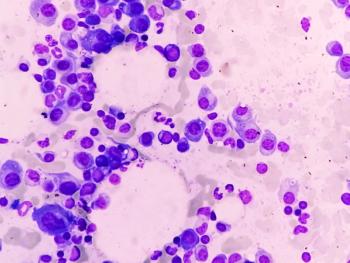
These therapies are being investigated in earlier lines, with several new treatments in development.

Dispensing, communicating, and recording information may look different at each center.

The tool can detect cell changes and mutations that drive resistance and relapse.
Panelists discuss how implementing novel combination therapies or emerging agents from clinical trials into real-world clinical practice for multiple myeloma faces significant challenges, including managing complex dosing regimens, addressing potential toxicities, ensuring patient adherence, navigating insurance coverage and cost issues, and bridging the gap between highly controlled trial conditions and diverse patient populations encountered in everyday clinical settings
Panelists discuss how a new therapy for multiple myeloma would need to demonstrate significant improvements in efficacy, safety, or quality of life over current standards of care to warrant adoption while also considering factors such as cost-effectiveness, patient preferences, and ease of administration in their decision-making process for evaluating treatment changes.
Panelists discuss how clinical trials in multiple myeloma can be improved to better reflect real-world scenarios and patient outcomes, emphasizing the importance of end points such as progression-free survival, overall survival, and quality of life measures, while also considering ways to increase trial inclusivity and applicability to diverse patient populations.
Panelists discuss how the introduction of triplet therapy prior to transplant in studies like IFM 2009 and DETERMINATION shifted the clinician mindset toward more intensive induction regimens, leading to a focus on achieving deeper responses and longer progression-free survival as primary goals of therapy for newly diagnosed multiple myeloma patients.

The real-world study results of ciltacabtagene autoleucel are comparable to data from the CARTITUDE-1 trial, emphasizing its efficacy and safety.
Panelists discuss how various patient characteristics, including age, fitness level, cytogenetic risk, and comorbidities, influence their decision to use more intensive quadruplet regimens like D-VRd (daratumumab plus bortezomib, lenalidomide, and dexamethasone) vs standard triplet regimens, such as VRd or KRd (carfilzomib, lenalidomide, and dexamethasone) in transplant-eligible multiple myeloma patients, while also considering administration logistics and supportive care requirements
Panelists discuss how transplant eligibility significantly influences first-line treatment goals and initial therapy selection in multiple myeloma, often leading to more intensive induction regimens aimed at achieving deep remissions.

The benefits of the daratumumab-based regimen were seen in all patients, including those with high and standard cytogenic risk levels.
Advertisement
Advertisement
Trending on Pharmacy Times
1
TrumpRx Launches, Offering Cash-Paying Patients Discounted Drugs
2
Pharmacist Takeover: CAR T Therapy Signals a Shift in ALL Treatment
3
SGLT2 Inhibitors in T2D Lower 5-Year Risk of CKD and Acute Kidney Injury
4
Strengthening Neurology Care Through Clinical Pharmacy Integration and Collaborative Practice
5